These images were selected to meet requests regularly received by the Library of Congress Prints and Photographs Division. This list represents a modified form of a printed “illustrated listR
Jim Crow laws were state and local laws enforcing racial segregation in the Southern United States. Enacted after the Reconstruction period, these laws continued in force until 1965. They mandated de
The objects displayed in Michigan’s newest museum range from the ordinary, such as simple ashtrays and fishing lures, to the grotesque – a full-size replica of a lynching tree. But all are
Who are the Legends of Tuskegee and what do they have in common? Booker Taliafero Washington, George Washington Carver and the Tuskegee Airmen all came to Tuskegee and created their own legends. Tuske
Lowcountry Africana, sponsored by the Magnolia Plantation Foundation of Charleston, South Carolina, is a free website dedicated to African American genealogy and history in South Carolina, Georgia and
Race and Place is an archive about the racial segregation laws, or the ‘Jim Crow’ laws from the late 1880s until the mid-twentieth century. The focus of the collection is the town of Charl
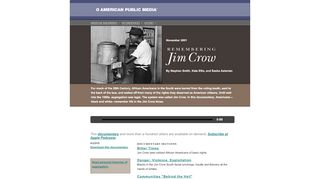
For much of the 20th Century, African Americans in the South were barred from the voting booth, sent to the back of the bus, and walled off from many of the rights they deserved as American citizens.
This digital archive/exhibit is an attempt at an historical reconstruction. It tries as much as possible, within the limitations of the documents that have survived, to recreate and interpret The Exhi
Jim Crow was not a person, yet affected the lives of millions of people. Named after a popular 19th-century minstrel song that stereotyped African Americans, “Jim Crow” came to personify t
Ignatius Sancho (1729-1780) was said to have been born a slave on a ship crossing the Atlantic from Africa to the West Indies. Although this is now thought to be unlikely, his origins were African whi
Marcus Mosiah Garvey, Jr., ONH (17 August 1887 – 10 June 1940),[2] was a Jamaican political leader, publisher, journalist, entrepreneur, and orator who was a proponent of the Pan-Africanism movement
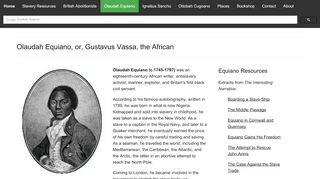
According to his famous autobiography, written in 1789, Olaudah Equiano (c.1745-1797) was born in what is now Nigeria. Kidnapped and sold into slavery in childhood, he was taken as a slave to the New